.png)
Immigration, Tariffs, and AI: A Conversation with Harvard-Educated Economist Stan Veuger
Updated: Jul 25
Catholic Leaders Alliance Interview
Event & Summary: Interview with economist Stan Veuger at the American Enterprise Institute on immigration, demographics, tariffs, AI, and policy limits, exploring how economic tools interact with broader social and institutional realities.
Through the Networking Catholics project organized by Father Matteo, professor at Università Cattolica del Sacro Cuore, a visit to the American Enterprise Institute in Washington, D.C. provided the opportunity to interview economist Stan Veuger. The discussion addressed key issues shaping the United States and Europe today: immigration, demographic decline, tariffs, judicial legitimacy, artificial intelligence, and the future of work.

Stan Veuger is a Senior Fellow at the American Enterprise Institute and a Future World Fellow at IE University. He has taught economics at Harvard and held visiting roles at institutions such as the Hoover Institution. He holds a Ph.D. in Economics from Harvard and has an international academic background spanning law, economics, and business.
1. Immigration, Demography, and the Fiscal Limits of Policy
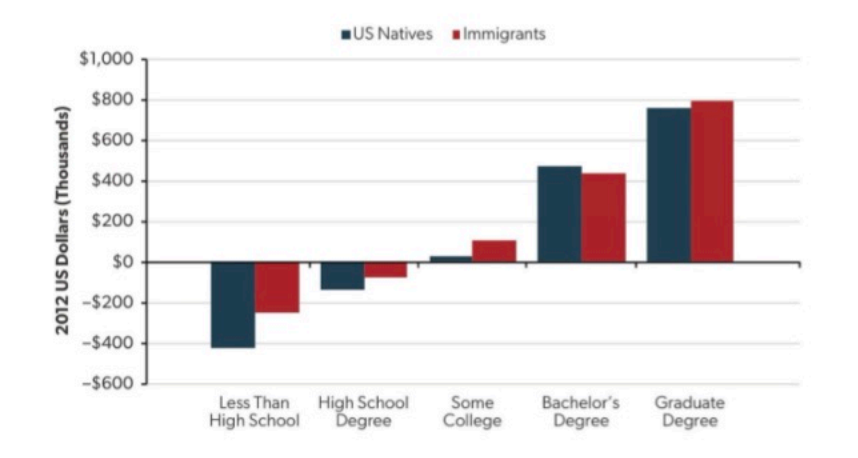
Chart comparing the estimated long-run fiscal contribution of U.S. natives and immigrants by
education level, showing a strong positive effect for bachelor’s and graduate degree holders.
The discussion began with the fiscal impact of immigration in the United States. Estimates suggest that immigrants with a bachelor’s or master’s degree may generate a long-term net positive fiscal impact of roughly $500,000 to $700,000, while lower-skilled immigrants may have a net negative fiscal impact. Approximately 41% of adult immigrants entering the United States hold a bachelor’s degree or higher, and only about one out of six green cards is employment-based.
Question: Should the United States shift its immigration system toward a greater focus on the type and quality of immigration it admits, particularly in light of fiscal considerations?
Veuger acknowledged the fiscal distinction between high-skilled and lower-skilled immigration. Highly educated immigrants tend to contribute more in taxes and rely less on public benefits. The most fiscally advantageous case involves individuals arriving in their mid-20s after completing education abroad and then working in the United States for their entire careers.
However, he cautioned against a purely high-skilled or employment-based system. The U.S. immigration framework is more complex, as many individuals entering through family reunification are indirectly linked to high-skilled migration, such as spouses of H-1B workers or former international students. Family reunification also carries intrinsic value, allowing citizens and permanent residents to live with close relatives.
Veuger further noted that concentrating immigration heavily at the top of the income distribution could create social and political imbalances. A system in which foreign-born individuals dominate higher income brackets while the rest of society remains largely native-born could become politically unstable.
The discussion then turned to international students and H-1B visas. Employers often hesitate to hire foreign graduates due to uncertainty surrounding visa sponsorship, particularly given the lottery-based system for private-sector H-1B visas.
Veuger emphasized that this uncertainty has worsened. While universities and nonprofits benefit from uncapped H-1B visas, private employers face significant constraints. He criticized the introduction of a $100,000 fee for H-1B beneficiaries, arguing that it reflects short-term thinking. High-skilled H-1B workers are typically among the most fiscally beneficial immigrants, and discouraging their entry could reduce long-term tax revenues.
The conversation then shifted to demographic trends. Between 2020 and 2023, immigration accounted for approximately 62% of U.S. population growth and 102% of labor-force growth, indicating that the labor force would have declined without immigration. At the same time, projections suggest that deaths may outnumber births in the future.
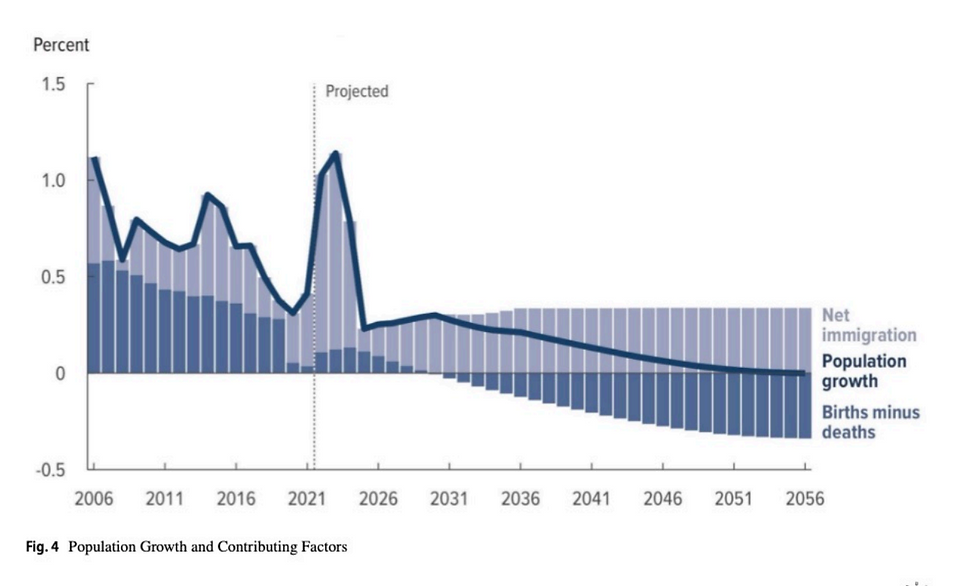
Chart showing U.S. population growth and its components, with net immigration
increasingly offsetting the decline in births minus deaths through 2056.
Question: Can immigration offset demographic decline, and can fiscal policy reverse falling fertility rates?
Veuger argued that current projections may underestimate the severity of demographic
challenges. Many forecasts assume around one million net immigrants per year, but actual levels may be significantly lower, potentially even negative. Under such conditions, population decline could begin as early as 2028 or 2029.
Regarding fertility, he expressed skepticism about the effectiveness of government intervention. Declining birth rates are observed across diverse political, cultural, and economic contexts. Even regions with strong religious traditions or generous welfare systems have not maintained replacement-level fertility. Cambodia, for example, has a fertility rate of approximately 0.89.
Two policy approaches were discussed: social-democratic models emphasizing childcare and parental leave, and conservative models focusing on tax benefits and financial support for families. While these policies may influence timing or slow decline, evidence suggests they are unlikely to restore fertility above replacement levels.
Veuger also highlighted the importance of family formation. Many individuals who remain childless never marry, suggesting that demographic policy may need to consider broader social dynamics rather than focusing solely on financial incentives.
2. Tariffs, Trade Deficits, and Institutional Restraint
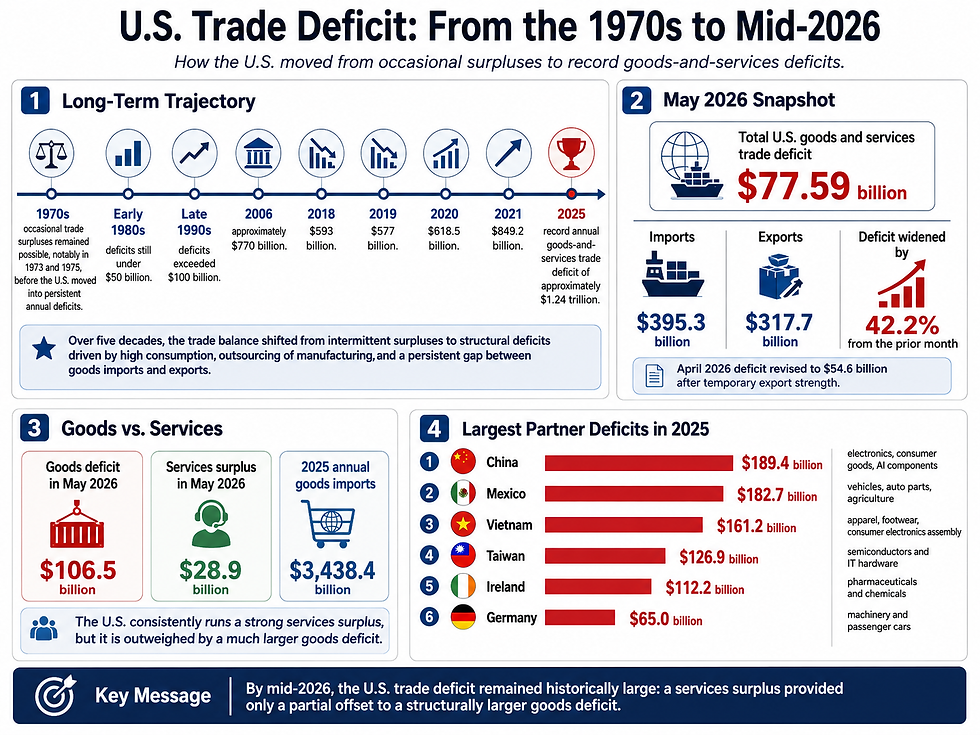
Infographic summarizing the evolution of the U.S. trade deficit from the 1970s to mid-2026, including recent import, export, goods, services, and partner-country deficit data. (The second part of the discussion addressed tariffs from conceptual, economic, and strategic perspectives.)
The United States currently runs a goods trade deficit of approximately $900 billion to over $1 trillion, while benefiting from strong capital inflows and the global role of the dollar.
Question: Are persistent trade deficits sustainable, or do they represent a structural risk?
Veuger argued that trade deficits are often misunderstood. The United States has maintained large deficits for decades, and these reflect capital inflows rather than inherent instability. A trade deficit corresponds to foreign investment in U.S. assets. Reducing the federal fiscal deficit could reduce the trade deficit, but foreign investment itself signals economic strength.
He also emphasized that concerns about trade deficits often reflect broader issues, such as manufacturing decline, regional disparities, and labor-market changes, rather than the deficit itself.
The discussion then turned to employment and wages.
Question: Do tariffs effectively protect jobs, or do they impose broader economic costs?
Veuger stated that tariffs generally have a negative net effect. While they may protect specific industries, they raise costs for downstream sectors. Nearly 100% of tariff costs can be passed on to consumers, and about half of imports consist of intermediate goods. Higher input costs reduce productivity and place downward pressure on real wages.
Tariffs may benefit visible sectors such as steel production, but they impose costs on less visible industries that rely on those inputs. As a result, they are not an effective tool for broad-based economic improvement.
The strategic use of tariffs was also examined.
Question: Can tariffs serve as an effective bargaining tool in international negotiations?
Veuger acknowledged that tariff-based negotiations may yield concessions, but he argued that broader geopolitical factors often play a more decisive role. In the case of U.S.–EU trade relations, European concessions may reflect security considerations, including reliance on U.S. defense commitments, rather than tariff pressure alone.
The institutional dimension of tariffs was also discussed. Under Article I of the U.S. Constitution, tariff authority resides with Congress, though significant powers have been delegated to the executive branch through legislation such as the Trade Act of 1974, Section 301, Section 232, and the International Economic Emergency Powers Act (IEEPA).
Veuger noted that IEEPA was historically used for sanctions rather than tariffs. Its use to justify broad tariff measures led to legal challenges, culminating in a Supreme Court decision rejecting expansive interpretations of executive authority. Approximately $166 billion in tariffs collected under this framework were subject to refund.
Subsequent reliance on Section 122 of the Trade Act, allowing temporary tariffs of up to 10% for 150 days, has also faced legal scrutiny. National-security-based tariffs under Section 232 may be more difficult to challenge due to judicial deference in such matters.
3. AI, Work, and Strategic Resilience
The final section addressed artificial intelligence, labor markets, and strategic sectors.
Veuger identified trade policy as a major concern for businesses, particularly those integrated into global supply chains. At the same time, he pointed to opportunities in AI, healthcare, defense, cybersecurity, and privacy.
Question: Can governments effectively anticipate and manage the labor-market effects of artificial intelligence?
Veuger expressed skepticism. Predicting which jobs will be affected by AI is inherently difficult. For example, software engineering has become a major area of AI application, despite earlier expectations that other fields would be more directly impacted.
He also questioned the effectiveness of narrowly targeted reskilling programs. Initiatives encouraging individuals to “learn to code” may become less relevant as AI systems increasingly generate code. Broader skills—such as adaptability, analytical thinking, and conceptual understanding—may prove more durable.
Healthcare was identified as a sector with predictable growth due to aging populations. In Europe, defense spending is also expected to increase significantly. A rise from approximately 1.5% to 3.5% of GDP would result in substantial investment in equipment, technology, and infrastructure.
The discussion concluded with supply-chain resilience.
Question: Does resilience require reshoring production, even at higher cost?
Veuger argued that resilience is better achieved through diversification rather than complete domestic production. During COVID-19, shortages were often driven by sudden demand spikes rather than solely by supply constraints. Even fully domestic production would not necessarily have prevented shortages.
He cited the U.S. infant formula shortage as an example of the risks of concentrated domestic production. Greater reliance on diversified international suppliers could have mitigated the impact of a single factory shutdown.
Conclusion:
Veuger’s perspective throughout the discussion emphasizes both the usefulness and the limits of economic policy. He highlights that high-skilled immigration can generate strong fiscal benefits, but warns against overly narrow systems that ignore social and political balance. He views demographic decline as a structural challenge that policy can only partially mitigate, especially given the limited effectiveness of fertility incentives. On trade, he argues that tariffs are generally inefficient and often misunderstood, while institutional constraints—particularly legal limits on executive power—remain essential. In the context of AI and labor markets, he stresses uncertainty and the difficulty of designing precise policy responses.
Key facts on Immigration and Demography
Immigrants and native-born Americans with bachelor’s or graduate degrees generate strongly positive long-run fiscal contributions, often in the range of $500,000 to $700,000 per person.
Only about 41% of newly arrived adult immigrants hold at least a bachelor’s degree, while around 46% have no education beyond high school.
Only around 17% of new green cards are employment-based, while nearly two thirds are family-related.
Between 2000 and 2023, immigrant-origin population growth accounted for about 62% of total U.S. population growth and 102% of labor-force growth.
The U.S. fertility rate is around 1.6 births per woman, below the replacement rate of roughly 2.1.
The worker-to-beneficiary ratio for Social Security has fallen from 5.1 workers per beneficiary in 1960 to about 2.7 today, and could approach 2.0 in the coming decades.
Increasing fertility takes roughly 20 to 25 years to affect the labor force, while immigration can add working-age adults immediately.
Key Facts on Trade Deficits, Tariffs, and the U.S. Economy
The U.S. trade deficit was around $900 billion in 2024, equal to about 3.1% of GDP.
The U.S. ran a $310.9 billion services surplus but a $1.2 trillion goods deficit.
Recent tariff pass-through was estimated to be close to 100%, meaning the burden largely fell on U.S. importers and consumers rather than foreign governments.
Imported-goods prices rose by 6.8% relative to the pre-tariff trend between March 2025 and May 2026, based on a study tracking more than 350,000 products across five large U.S. retailers.
Some categories saw especially large increases: 54% for carpets and floor coverings, 24% for clothing and accessories, and 16% for coffee, tea, cocoa, fish, and seafood.
Tariffs can be regressive: one estimate suggested a 2.0% after-tax income reduction for the bottom 95% of households.
In steel, there are about 80 jobs in steel-using industries for every 1 job in steel production, showing why upstream protection can impose costs on many more downstream workers.
Trump-era tariff policies were estimated to reduce long-run economic output by 0.4% to 0.6%.
In 2025, customs duties generated about $264 billion, around $185 billion more than in 2024, but even projected over ten years this would represent at most about 4% of total federal revenue.

Italian delegation of the Networking Catholics program outside the American Enterprise Institute in Washington, D.C.
July 23, 2026