.png)
Overview of Global Developments - June 2026 Report
June 2026 brought together several developments across geopolitics, European policy, markets, technology, and society. The report covers the fragile truce after the Iran war, Europe’s defense and trade agenda, the progress of the digital euro, major market events involving SpaceX and Bending Spoons, and demographic trends in Italy, Japan, and Switzerland. Together, these events offer a snapshot of the main political, economic, and social issues shaping the month.
I. GEOPOLITICS & SECURITY
The Iran War: From High-Intensity Conflict to Fragile Truce

By late June 2026, the Iran war appears to have moved out of its most intense military phase and into a fragile truce. The conflict has not ended cleanly; it has changed form. The battlefield is no longer defined only by airstrikes, land operations, or direct military offensives, but by maritime pressure, unresolved diplomacy, reconstruction costs, and regional instability.
The Strait of Hormuz remains the central flashpoint. The attack on the Singapore-flagged cargo ship Ever Lovely near Oman, followed by the suspension of UN-backed escort operations, showed that the ceasefire remains highly vulnerable. Hormuz handles roughly one fifth of global oil and gas trade, meaning even limited incidents can quickly affect insurance costs, shipping routes, oil prices, and global inflation.
The dispute is now increasingly about control of maritime passage. Iran has argued for new crossing protocols and has floated the idea of charging “security” or “service” fees for ships transiting the strait, potentially generating tens of billions of dollars per year. The United States and Gulf states have rejected this logic, arguing that Iran cannot unilaterally impose tolls on one of the world’s most important commercial corridors.
The economic burden is also becoming more visible. The White House has requested an $87.6 billion supplemental package, with $67.1 billion linked to the Iran conflict and $21 billion for munitions and defense-industrial support. Separate estimates suggest that the war has already cost the average American household around $1,000 through higher fuel prices, diesel-driven delivery costs, airfares, military spending, and potential interest-rate effects.
Lebanon remains the main regional wildcard. Tens of thousands of people remain displaced, more than 90,000 homes have been damaged or destroyed, and Israel still controls a buffer zone in southern Lebanon. Negotiations over a pilot withdrawal zone remain fragile, with disputes over troop movements, Hezbollah infrastructure, and who should control the territory after withdrawal.
The E5 Meeting in Berlin and Europe’s Defense Burden

Map highlighting the E5 countries — Germany, France, the United Kingdom, Italy, and Poland — ahead of the NATO summit and renewed European defense coordination.
The Berlin meeting of the E5 — Germany, France, the United Kingdom, Italy, and Poland — reflected Europe’s attempt to coordinate its defense position ahead of the NATO summit in Ankara on July 7–8. The format brings together five of Europe’s major military and political powers and has become increasingly relevant as Europe faces pressure to take greater responsibility for its own security.
The meeting was hosted by German Chancellor Friedrich Merz and focused on strengthening the European pillar of NATO while preserving the transatlantic bond. This balance is central to Europe’s current strategy. European leaders want to show unity toward Washington, but they also recognize that future U.S. commitments may become more conditional, especially as American political pressure grows for Europe to spend more and do more.
The context is a major shift in NATO defense planning. Secretary General Mark Rutte said the upcoming summit would announce tens of billions of dollars in new defense-related contracts. NATO’s longer-term goal is to move toward defense and security spending equal to 5% of GDP by 2035, a dramatic increase compared with the older 2% benchmark that shaped alliance debates for years.
The E5 meeting also followed tensions among European allies over defense projects, industrial cooperation, and Ukraine policy. Italy and Poland have pushed for broader inclusion in European security discussions, especially when smaller formats such as the E3 — France, Germany, and the United Kingdom — dominate the agenda.
The Berlin meeting points to a new phase in European security. NATO remains the framework, but Europe is increasingly expected to provide more money, more industrial capacity, and more political leadership.
China’s “Spy Turtles” and the New Maritime Intelligence Race
China’s Ministry of State Security has accused foreign intelligence agencies of using new maritime surveillance technologies to collect sensitive data in Chinese waters. The most unusual part of the accusation concerns marine animals equipped with sensors, described in media reports as “spy turtles” and “spy fish.”
According to Beijing, these animals were fitted with devices capable of monitoring water temperature, salinity, currents, and other oceanographic conditions, with data transmitted abroad by satellite. Chinese authorities also claimed to have discovered sensor-equipped buoys, ocean drones, wave gliders, and electronic devices installed on ships, all allegedly capable of collecting information useful for maritime intelligence.
The most sensitive element concerns submarines. Some buoys reportedly contained high-precision acoustic sensors able to collect real-time data, including the sound signatures of Chinese submarines. In underwater warfare, acoustic information is extremely valuable because submarines are often detected through the sounds they emit and through sonar conditions shaped by water temperature, salinity, currents, and seabed geography.
The allegations have not been independently verified in full, and China did not publicly identify which foreign agencies were allegedly responsible. However, the broader issue is serious: maritime surveillance has become central to great-power competition, especially in the South China Sea, East China Sea, and Taiwan Strait.
Chinese authorities have urged citizens, fishermen, and ship operators to report suspicious devices and avoid installing equipment of unknown origin. Reports also indicate that China offers financial rewards for recovering suspected maritime spying devices, ranging from 50,000 to 500,000 yuan.
II. INSTITUTIONS & TRADE
Keir Starmer’s Resignation and the Fragility of Political Mandates
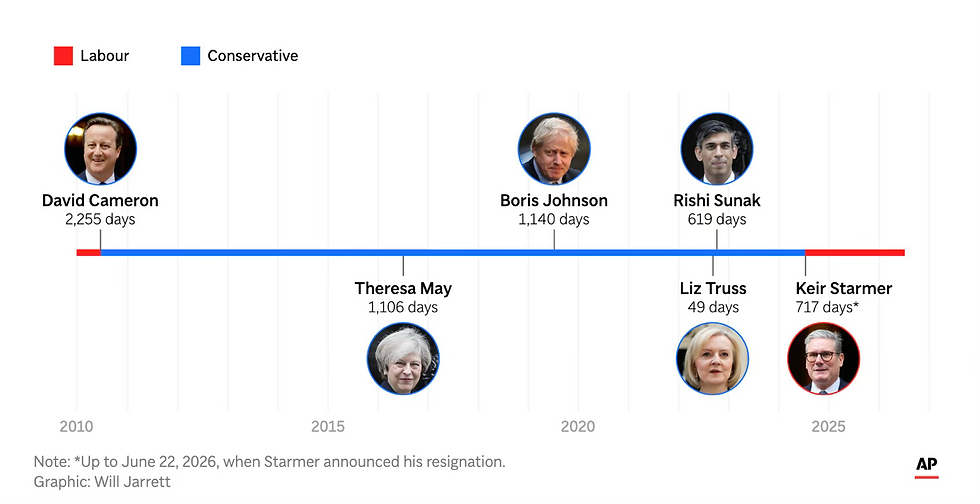
Timeline of recent British prime ministers, showing the instability of UK leadership from David Cameron to Keir Starmer
Keir Starmer’s resignation as British prime minister marked one of the most sudden political collapses in recent UK politics. Less than two years earlier, Labour had returned to power after 14 years of Conservative government, winning 411 of the 650 seats in the House of Commons in July 2024. That victory had been presented as the beginning of a period of stability after years of political turbulence. By June 2026, however, Starmer’s leadership had lost momentum inside his own party.
The immediate pressure came after Labour’s poor performance in local and regional elections on May 7, which triggered internal resignations, criticism, and leadership challenges. Starmer announced that he would step down but remain in office during the transition, allowing the Labour Party to select a new leader and therefore a new prime minister.
The succession process is expected to move quickly. Nominations for the Labour leadership are set to open on July 9 and close before Parliament begins its summer recess on July 16. The contest is restricted to Labour members of Parliament, meaning the next prime minister will emerge from inside the parliamentary party rather than through a general election.
Andy Burnham, former mayor of Greater Manchester, has become the leading candidate to replace Starmer. His return to Parliament through a special election gave him the institutional position needed to compete for the leadership.
Starmer’s resignation shows how quickly a large parliamentary majority can become politically fragile. Electoral victory alone does not guarantee authority if economic pressure, party divisions, and public frustration begin to accumulate.
The EU–U.S. Tariff Agreement: A Conditional Reset
The European Union has given final approval to the tariff agreement with the United States, formally completing the legislative process linked to the EU–U.S. Joint Statement of August 21, 2025. The agreement is designed to stabilize transatlantic trade after months of tariff uncertainty, while also protecting Europe’s ability to respond if the balance of the deal is not respected.
The Council of the European Union adopted two regulations. The first removes the remaining EU customs duties on U.S. industrial goods. The second introduces preferential access for selected U.S. agricultural and seafood products considered “non-sensitive,” using reduced tariffs and tariff-rate quotas. The agreement also extends the suspension of tariffs on lobster imports, including processed lobster.
For the United States, the deal creates easier access to the European market for industrial exporters, farmers, and seafood producers. For the European Union, the logic is more defensive: by implementing tariff concessions, Brussels aims to preserve a stable commercial relationship with Washington and reduce the risk of further escalation.
However, the agreement is not unconditional. The regulations include reinforced safeguard and suspension mechanisms. If U.S. imports increase sharply and cause, or threaten to cause, serious harm to European producers, the European Commission can intervene. The EU can also suspend tariff preferences if the United States fails to respect its commitments or adopts measures that undermine the balance of the agreement.
The Digital Euro and Europe’s Search for Monetary Sovereignty

The digital euro has taken an important step forward in the European legislative process. After years of discussion, the European Parliament gave a first approval to the project, following the Council of the European Union’s earlier approval in December. If final negotiations between Parliament and Council are completed by the end of 2026, the digital euro could enter into use around 2029.
The project began when the European Central Bank started studying its feasibility in 2020. The European Commission then presented a legislative proposal in 2023. The idea is to create a digital form of central-bank money: not a cryptocurrency, and not a private payment app, but an electronic version of the euro issued by the ECB and accepted across the eurozone.
The digital euro would likely work through a digital wallet, allowing people to pay in shops, online, and from person to person. It would have legal tender status, meaning it would have to be accepted in eurozone countries. Consumers would not pay fees, while merchant fees would be reduced and regulated by law.
Supporters argue that the project would reduce Europe’s dependence on foreign payment networks such as Visa, Mastercard, American Express, PayPal, Apple, and Google. In this sense, the digital euro is not only a monetary project but also a sovereignty project.
The debate is politically sensitive. Supporters come mainly from the center, the left, and part of the European People’s Party. Critics, especially from right-wing and nationalist groups, fear that it could weaken cash or increase the traceability of payments. The ECB insists that “one euro remains one euro” and that cash will not disappear.
The numbers show why the debate matters. In the eurozone, cash use fell from more than 79% of transactions in 2016 to 52% in 2024. In Italy, cash remains more common: it is still used for about 61% of transactions, down from 82% in 2019. For this reason, Italian, German, and Austrian politicians have been among the most sensitive to the cash debate.
Banks are also concerned. If people move too much money from bank accounts into digital euro wallets, banks could lose deposits used for lending. For this reason, the ECB has discussed limits of around €3,000–€4,000 per wallet, with no interest paid on digital euro balances.
III. ECONOMY, MARKETS & GLOBAL BUSINESS
SpaceX: Record IPO, Volatility, and Paper Wealth

Elon Musk speaking at a SpaceX event, with the company positioned at the center of space infrastructure, satellite connectivity, and public-market expectations.
SpaceX’s entry into public markets was one of the largest financial events of the year. The company raised more than $85 billion in its IPO, making it one of the biggest listings in market history and reinforcing its image as one of the most valuable technology and space companies in the world.
The numbers were extraordinary. SpaceX went public at $135 per share, and in its first phase of trading the stock reached a high of $201.80. On the first day, the stock rose 19%, briefly pushing the company’s valuation above $2 trillion. At one point, SpaceX was ranked among the most valuable companies in the world, despite still being unprofitable.
However, the first phase of trading also showed how quickly market enthusiasm can turn into volatility. After reaching its high, SpaceX shares fell more than 16% in a single day and closed at $154.60. The decline marked the third consecutive day of losses and reflected broader pressure on technology stocks, but also growing caution toward SpaceX’s financial structure.
The company is now preparing a major bond-market debut. Initial reports indicated a possible $20 billion debt offering, later expanded to as much as $25 billion because of strong investor demand. The purpose is to repay a bridge loan and support broader corporate activities. Ratings agencies granted SpaceX investment-grade ratings, citing its dominant market position, reusable rocket technology, and strong growth profile.
At the same time, the bond sale raised concerns. SpaceX remains a capital-intensive company, with heavy investment needs across launch systems, Starlink, AI-related infrastructure, and future space programs. The company also reported a $4.9 billion loss last year, meaning public-market investors will now examine its profitability more closely than private backers did.
The IPO also had a major effect on Elon Musk’s personal wealth. As SpaceX shares surged, Musk briefly crossed the symbolic threshold of $1 trillion in net worth, becoming the first person to reach that level on paper. But the moment was short-lived. After the stock retreated, Musk’s estimated wealth fell back to around $946 billion.
Bending Spoons and the Nasdaq: Italy’s Tech Champion Goes Global
Bending Spoons, the Milan-based technology company behind brands such as Vimeo, WeTransfer, Evernote, AOL, Eventbrite, Remini, StreamYard, and Komoot, has filed for a Nasdaq listing under the ticker symbol BSP. If successful, the IPO would mark one of the most important international listings for an Italian technology company.
Founded in 2013, Bending Spoons has built its model around acquiring digital businesses and improving their performance. It operates partly like a technology operator and partly like a private-equity-style platform. It buys established internet products, restructures them, and attempts to make them more profitable. Unlike traditional private equity, however, Bending Spoons says it does not normally sell major assets after acquiring them.
The company’s growth has been rapid but heavily financed. According to its IPO filing, Bending Spoons accumulated $4.36 billion in debt following a series of acquisitions. This debt level is one of the central questions for investors, because the company’s expansion strategy depends on its ability to integrate acquired brands while maintaining financial discipline.
The financial picture is mixed but improving. In 2025, Bending Spoons recorded a net loss of $112 million on revenue of $259 million. In the first quarter of 2026, it reported net income of $27.5 million on revenue of $601 million, showing a sharp turnaround.
The user base has expanded quickly. Monthly active users increased from 111 million in December 2023 to 500 million in March 2026. Paying customers rose from 3 million to 9 million over the same period.
Reuters reported that Bending Spoons could raise up to $1.62 billion in the IPO, offering 58 million shares at a price range of $26 to $28. At the top of the range, the company could reach a valuation of around $19 billion, compared with an $11 billion valuation in its October 2025 funding round.
The listing is significant because it shows how European technology companies often look to U.S. markets for scale, liquidity, and higher valuations. For Italy, Bending Spoons represents an unusual case: a domestic tech company with global consumer platforms, large-scale acquisitions, and public-market ambitions.
Venezuela’s Debt Restructuring: A Historic Test

Delcy Rodríguez, head of Venezuela’s interim government, during a public address as the country prepares a historic sovereign debt restructuring.
Venezuela is preparing what could become the largest sovereign debt restructuring in history. The interim government led by Delcy Rodríguez intends to recognize close to $240 billion in debt, far above previous market estimates of $150–200 billion.
The scale of the operation would be larger than Greece’s historic 2012 debt restructuring. For Venezuela, the objective is to reach an agreement with creditors by the end of the year and return to international financial markets after almost a decade of exclusion.
The restructuring comes after a major political turning point. Following the capture of Nicolás Maduro in January, Delcy Rodríguez assumed leadership of the interim government. Caracas has hired the U.S. investment bank Centerview Partners to prepare a debt sustainability plan, expected at the beginning of July, together with a new macroeconomic framework.
The numbers show the depth of the crisis. Venezuela’s economy has shrunk to around $100 billion, compared with $370 billion in 2012, the final year of Hugo Chávez. The best-documented part of the debt includes about $60 billion in government and PDVSA bonds, plus another $40 billion in interest accumulated since default. Additional obligations include debts to oil companies, suppliers, compensation claims linked to expropriations, and loans owed to China and Russia.
The central question is oil. The Venezuelan central bank reported $5.5 billion in oil revenues in the first quarter, a slight improvement compared with the final phase of the Maduro era, but still far from pre-sanctions levels. Without a strong recovery in oil production and exports, debt sustainability will remain uncertain.
The Cost of Mobility in Italy
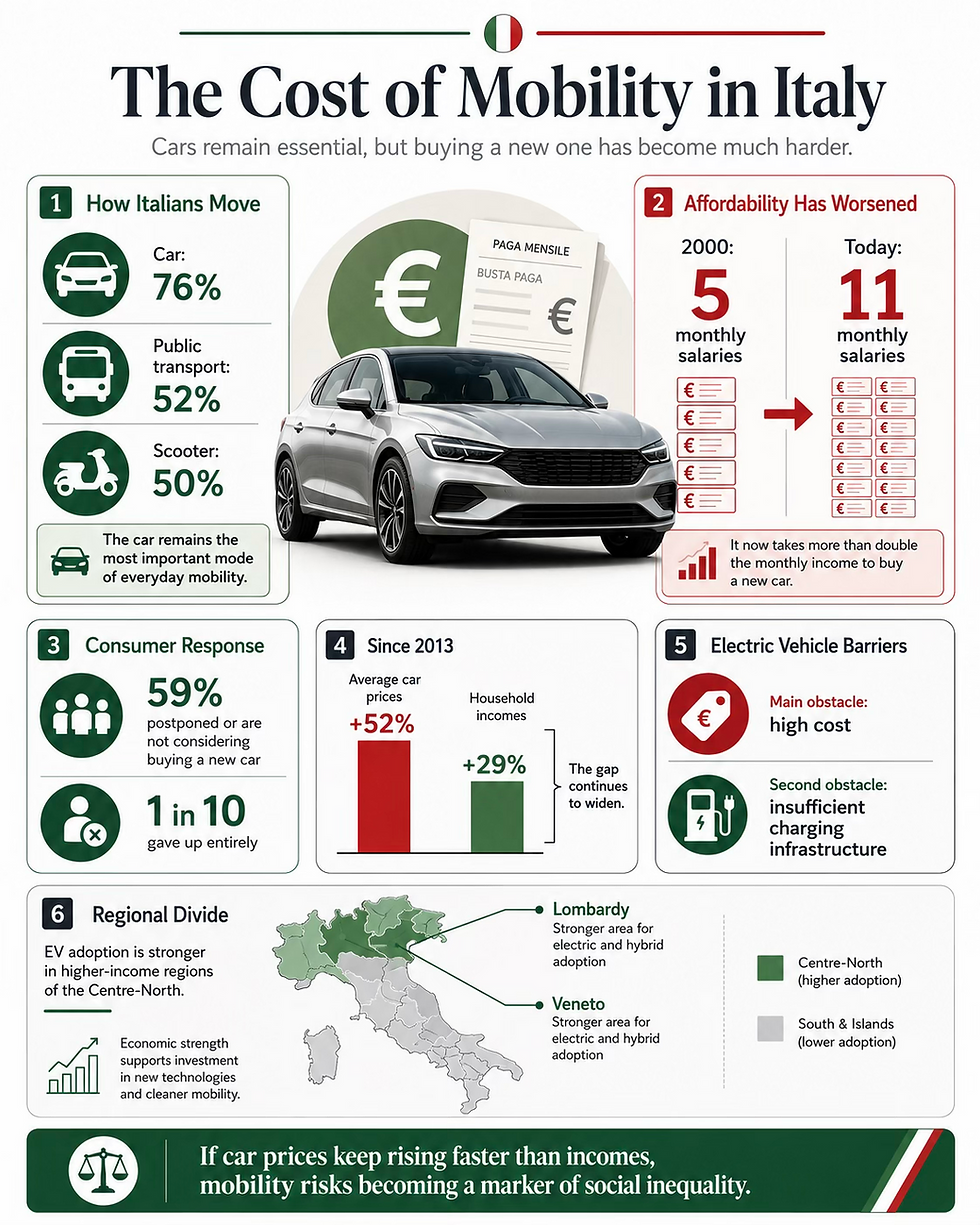
The car remains central to everyday mobility in Italy, but buying a new one has become increasingly difficult. According to a Bain & Company survey conducted with Aniasa, the automobile is still used by 76% of Italians for daily mobility needs, ahead of public transport at 52% and scooters at 50%.
The problem is not a lack of demand. It is affordability. Today, buying a new car requires an average of 11 monthly salaries. In 2000, the same purchase required around 5 monthly salaries. In other words, the effort needed to buy a car has more than doubled in a generation.
This has changed consumer behavior. Around 59% of consumers say they have postponed or are not considering the purchase of a new car, while one in ten has given up entirely. Since 2013, average car prices have increased by 52%, driven by inflation, supply-chain disruptions, new safety equipment, the shift toward electric powertrains, and a market increasingly focused on SUVs and higher segments rather than cheaper compact cars. Over the same period, household incomes increased by only 29%.
The transition to electrified vehicles is also affected. More than half of respondents identify high cost as the main obstacle to buying an electrified car. The second major barrier is the lack of adequate charging infrastructure. This creates a geographic and social divide: electric and hybrid adoption is stronger in higher-income regions of the Centre-North, such as Lombardy and Veneto, and weaker where incomes and infrastructure are more limited.
China’s Rise as a Medical-Tourism Destination

China is emerging as a new destination for medical tourism, but not in the traditional sense. For decades, medical tourism was mostly associated with dentistry, cosmetic surgery, or fertility treatments. China is positioning itself differently: as a destination for advanced and potentially life-saving treatments, especially in oncology.
The case of Stuart Lye, a 58-year-old New Zealander with multiple myeloma, illustrates the trend. In 2018, doctors had estimated that he had only three months to live. After years of chemotherapy, stem-cell transplants, and new drugs, his options in New Zealand were exhausted. CAR-T therapies were not commercially available in his country, and a treatment would have cost more than 350,000 Australian dollars, over 200,000 euros.
In 2025, Lye travelled to Shanghai for treatment. After seven weeks in a Chinese clinic, his cancer was brought under control at a total cost of around $65,000. In the United States, a single CAR-T infusion can cost between $300,000 and $475,000. In China, similar treatments are priced around $150,000–$180,000, and new therapies could fall below 300,000 yuan, around $44,000.
China has already approved seven CAR-T therapies, the same number as the United States, and leads the world in the number of CAR-T clinical trials. In 2024, China matched the United States in the number of experimental drugs entering clinical testing, while completing trials two to five times faster than the U.S. and the European Union.
The market opportunity is significant. Global medical tourism is currently estimated at around $34 billion and could reach $126 billion by 2035. China’s segment could grow from $1.3 billion to $3.4 billion over the same period.
However, the risks are serious. When patients with critical illnesses pay out of pocket for experimental or advanced treatments, safety standards, transparency, and profit incentives become central concerns.
Capsule Hotels and the Rise of Urban Minimalism

Interior of a capsule hotel, showing the compact sleeping pods that originated in Japan and are now spreading as a low-cost urban hospitality model.
Capsule hotels began in Japan as a practical solution for workers who needed a cheap place to sleep after missing the last train. The first example, Capsule Inn Osaka, opened in 1979 and was designed by architect Kisho Kurokawa. It offered a small, functional sleeping space without the cost or services of a traditional hotel room.
The model has changed significantly since then. What began as emergency accommodation for Japanese salarymen has become an international travel format, especially attractive to solo travelers, young tourists, business commuters, and people looking for affordable accommodation in expensive city centers.
The basic structure is simple. Guests sleep in individual cabins roughly the size of a bed, often arranged on two levels along long corridors. Inside the capsule there is usually a mattress, adjustable light, power outlet, ventilation or air conditioning, and a small space for personal items. Larger luggage is kept in external lockers because there is almost no room inside the capsule itself.
In 2025, London opened what was described as the largest capsule hotel in the world, in the Piccadilly area. The Zedwell hotel includes around 1,000 capsules, with prices starting from £30 per night. In a city where central accommodation is often extremely expensive, this makes the model commercially attractive.
Capsule hotels often work like a hybrid between hotels and hostels. Guests share bathrooms, relaxation areas, co-working spaces, and sometimes cafés or bars. Compared with traditional hostel dormitories, capsules offer more privacy; compared with hotels, they offer less comfort but a much lower price.
The spread of capsule hotels shows a broader shift in urban travel. Many people increasingly prefer to spend less on accommodation and more on experiences, restaurants, and activities. For others, the attraction is convenience: a central location, a clean bed, and a simple place to rest.
Capsule hotels are not for everyone. They can feel claustrophobic, impersonal, and highly standardized. But their expansion from Japan to Europe shows how rising travel costs and changing lifestyles are creating demand for smaller, cheaper, and more efficient forms of hospitality.
IV. SOCIETY, DEMOGRAPHY & MIGRATION

Italy’s Internal Brain Drain
Italy’s demographic crisis is not only about low birth rates or emigration abroad. It is also about internal migration. Between 2019 and 2026, the population aged 18 to 35 declined sharply in Southern Italy, while Northern Italy gained young residents. This movement confirms one of the most persistent structural divides in the country: the South continues to lose part of the generation that should sustain its future.
Since 2019, the number of residents aged 18 to 35 in the Mezzogiorno has fallen by 7.6%, dropping from more than 4.1 million to around 3.8 million. This means that the South has lost more than 313,000 young people in six years. During the same period, Northern Italy gained almost 240,000 young residents, increasing from 4.95 million to 5.19 million, a rise of 4.8%. Central Italy remained broadly stable.
The provincial map shows the scale of the imbalance. The strongest increases were recorded in Gorizia, up 10.9%, followed by Genova at 8.4%, Bologna at 8.1%, Pavia at 7.2%, and Reggio Emilia at 6.6%. The sharpest losses were concentrated in the South and the islands: South Sardinia lost 13% of its under-35 population, while Oristano fell by 12.1%. Other provinces such as Isernia, Crotone, Potenza, and Reggio Calabria also recorded double-digit declines.
This is more than a demographic statistic. When young people leave, local economies lose workers, taxpayers, entrepreneurs, students, and future families. The South is not only aging; it is also losing part of its most mobile and qualified population.
The Real Causes of Demographic Collapse
The global fertility collapse is no longer limited to wealthy countries. It now affects a large part of the world, including middle-income and developing economies. In more than two thirds of the world’s 195 countries, fertility has fallen below the replacement rate of 2.1 children per woman. In 66 countries, the average is now closer to one child than to two.
The speed of the decline has surprised even international institutions. Five years ago, the United Nations expected South Korea to record around 350,000 births in 2023. The real number was about 230,000, meaning the projection was roughly 50% too high. Similar declines have appeared in countries as different as Mexico, Brazil, Tunisia, Iran, Sri Lanka, and several parts of Southeast Asia.
The usual explanations are economic: housing costs, job insecurity, career pressure, and the high cost of raising children. These factors matter. But the deeper shift may be that fewer couples are forming in the first place. In the past, fertility fell mainly because couples had fewer children. Today, in many countries, fertility is falling because fewer people are entering stable relationships.
This changes the interpretation of demographic decline. If the problem were only that couples choose to have fewer children, family bonuses and childcare support might be enough. But if the problem begins earlier, at the stage of dating, cohabitation, marriage, and long-term commitment, demographic policy must look beyond childbirth.
The data suggest a “K-shaped” family pattern. Among higher-income and more educated groups, the formation of couples and families is more stable. Among lower-income and less educated groups, the decline is much sharper. This means demographic decline is also becoming a social inequality issue.
Government spending has not reversed the trend. Since the 1980s, developed countries have tripled real per-capita spending on family allowances, childcare, and parental leave. Yet fertility still fell from 1.85 to 1.53 children per woman.
Housing is another major factor. Analysis suggests that up to half of the fall in births since the 1990s can be linked to declining home ownership and the rise of young adults living with their parents. Digital life may also play a role, as smartphones and mobile internet are associated with lower in-person social interaction and weaker romantic formation.
Japan’s Immigration Dilemma
Japan is facing one of the most difficult demographic contradictions in the developed world. The country needs foreign workers because its population is aging rapidly and its labor force is shrinking. At the same time, the government is moving toward stricter and more expensive rules for foreigners who want to live and work in the country.
At the end of 2025, foreign residents in Japan reached 4.13 million, the highest level ever recorded. Among them were around 5,000 Italians. This growth has been driven mainly by Asian workers, students, and skilled professionals who moved to Japan to support local companies and fill labor shortages.
The demographic pressure is clear. Around 29% of Japan’s population is over 65, making it one of the oldest societies in the world. Foreign workers are becoming increasingly necessary for the economy, especially in sectors affected by labor shortages.
However, the government is preparing measures that would make residency more difficult. The renewal of residence permits could rise to about €555, compared with the current cost of around 6,000 yen, or just over €30. Japan also plans to strengthen checks on employment history, workplace location, tax documentation, and intra-company transfers. Incomplete or false information could lead to refusal of renewal or a shorter residence period. Permits can range from three months to five years.
Another major change is the language requirement. Foreign residents seeking permanent residence may be required to prove knowledge of Japanese, with some roles potentially requiring a level close to B2, especially in public-facing or administrative jobs.
Switzerland’s Population Referendum and the Politics of Limits
Switzerland is debating whether population growth should have a political limit. A referendum titled “No to a Switzerland of 10 million” proposed preventing the resident population from exceeding 10 million before 2050. The initiative reflects concern about migration, housing, infrastructure, public services, and environmental pressure.
At the end of 2025, Switzerland had around 9.1 million inhabitants. The proposal would activate measures already at the threshold of 9.5 million, which current trends suggest could be reached around 2032. Since the introduction of free movement of people in 2002, Switzerland’s population has increased by about 1.7 million.
The issue is politically sensitive because the initiative does not target Swiss births. In practice, it would mainly affect immigration: foreign workers, asylum seekers, and family reunification. Switzerland’s annual population increase is about 70,000 people, with roughly two thirds linked to positive net migration and one third to the natural balance between births and deaths.
Supporters argue that population growth has contributed to housing shortages, rising rents, congestion, pressure on trains and roads, strain on healthcare, and declining quality in education. Opponents, including the federal government and Parliament, argue that a strict population cap would damage the economy, reduce prosperity, create internal security risks, and impose major costs on the Confederation and the cantons.
The referendum also included a second issue: reform of the civil service system. The proposed change would require civilian service members to complete an additional 150 days, making civilian service more demanding for those who choose it instead of military service.
V. CULTURE, RELIGION & SOCIAL CHANGE
Cardinal Ruini and the Public Role of Italian Catholicism

Cardinal Camillo Ruini, former President of the Italian Episcopal Conference and former Vicar General of Rome, speaking during a religious ceremony.
The death of Cardinal Camillo Ruini at the age of 95 reopened a broader reflection on the role of the Catholic Church in Italian public life. Ruini was not only a senior churchman. He was one of the most influential figures in the relationship between faith, politics, and society in postwar Italy.
As president of the Italian Episcopal Conference and Vicar of the Pope for the Diocese of Rome, Ruini became a central figure in the Church of John Paul II. His leadership lasted for almost two decades and gave the Italian Church a strong public presence at a time when the old Christian Democratic system was collapsing and the country was entering the Second Republic.
The term “ruinismo” came to describe a model of Catholic public engagement in which the Church did not remain outside political life, but actively intervened in the national debate. Ruini’s influence was visible in ethical, social, and cultural issues, where the Church sought to shape public discussion after the decline of the Democrazia Cristiana.
His biography also reflects the complexity of Italian Catholicism. In the 1970s, in Reggio Emilia, Ruini helped build the Studenti Democratici, a Catholic student movement that opposed the influence of the Communist youth federation. That early experience anticipated a much larger conflict inside Italian society: the confrontation between Catholic political culture, secularization, left-wing traditions, and emerging forms of liberal modernity.
Ruini was closely associated with John Paul II’s global strategy. If Joseph Ratzinger represented the theological and intellectual strength of that period, Ruini represented its organizational and political effectiveness in Italy. He built influence, managed institutions, and gave the Church a stable voice in a rapidly changing political system.
His legacy remains contested. Some see him as a defender of Catholic identity in an increasingly secular society. Others see him as the symbol of a Church too closely involved in political power. In either case, Ruini’s life shows that Italian Catholicism cannot be understood only as a spiritual force. For decades, it was also one of the country’s most important political and cultural actors.
SITOGRAPHY
ANSA. “Via libera definitivo UE ad accordo sui dazi con gli USA.” June 25, 2026.
AGI. “SpaceX precipita a Wall Street.” June 22, 2026.
AGI. “Adozione euro e criteri di convergenza.” June 25, 2026.
Associated Press. “Keir Starmer resignation: UK prime minister updates.” June 22, 2026.
Avvenire. “Gli svizzeri decidono se sia meglio non essere in troppi.” June 2026.
Europa Today. “Vertice NATO, E5 a Berlino.” June 2026.
Euronews Business. “Venezuela avvia la più grande ristrutturazione del debito della storia dopo la caduta di Maduro.” June 24, 2026.
Il Post. “Il Parlamento Europeo ha dato una prima approvazione all’euro digitale.” June 25, 2026.
Il Post. “I capsule hotel in Giappone.” June 21, 2026.
Il Sole 24 Ore. “Keir Starmer si dimette da primo ministro.” June 2026.
Il Sole 24 Ore. “La Cina nuova meta del turismo sanitario: cure innovative salvavita a metà prezzo.” June 2026.
Internazionale. John Burn-Murdoch, “I veri motivi del crollo demografico.” June 11, 2026.
La Repubblica Motori. “Oggi servono 11 stipendi per comprare un’auto: prezzi saliti del 52% dal 2013, i redditi del 29%.” June 25, 2026.
Libero Tecnologia. “Elon Musk verso i mille miliardi con SpaceX e l’IPO.” June 2026.
Money.it. “Nuove regole in Giappone per italiani e stranieri: ora dovete lasciare il Paese.” June 2026.
Morningstar Italy. “Bending Spoons, società proprietaria di Vimeo, presenta domanda di quotazione al Nasdaq.” June 2026.
TGCom24. “Cina, intelligence e tartarughe spia.” June 2026.
Unione Sarda. “Giovani in fuga verso il Nord Italia: in sei anni il Sud Sardegna perde il 13% di under 35.” June 2026.
Zeta Luiss. “Un uomo di Chiesa e soprattutto di politica.” June 17, 2026.
24Emilia. “Camillo Ruini, figli del Concilio.” June 2026.
Additional sources consulted for the Iran War update
Reuters. Reporting on the Strait of Hormuz, maritime security, oil and gas transit, Lebanon, and the fragile ceasefire framework. June 2026.
The Wall Street Journal. Reporting on Iran’s proposed maritime service fees and the strategic dispute over the Strait of Hormuz. June 2026.
The Guardian. Reporting on the U.S. supplemental funding request linked to the Iran conflict and defense-industrial support. June 2026.
Business Insider. Reporting on estimated household-level costs of the Iran conflict through fuel, transport, military spending, and inflationary effects. June 2026.
